Moonfall.
01 / 14
Pamplemoose Games × The Moonfall Series · Concept Pitch

Moonfall:
The Hunt

A trading card game set in the world of When the Moon Hatched. Two players, three realms, and a hunt that ends when one of them is dead. Where the ground under you is the mechanic, not the theme.

Working title · Concept pitch · September 2026

The thesis

This world is already
built like a card game.

Three realms with fixed conditions. Five Creators with colour-coded affinities worn openly as beads. Dragon species that cannot survive outside their own climate. A rarity curve stated on the page: one song is typical, two is lucky, three makes you politically significant.

None of that was designed as a game and all of it behaves like one. We did not reskin a card game onto this world. We derived one out of it.

And yes, we know about Skripi. There is already a card game inside these books, and Sarah has spoken about wanting it to be real. We have deliberately not built it. More on that later in this deck.
What it is

A two-player duelling
card game with a map.

1

The three realms sit side by side as lanes, in the order the world sits in: Burn, Fade, Shade.

2

You field Folk, dragons and songs into those lanes. Each lane is lethal to something.

3

You can only reach an enemy from inside their own lane.

4

So you go where they are, and the ground starts killing what you brought.

5

Win by killing the opposing hero.

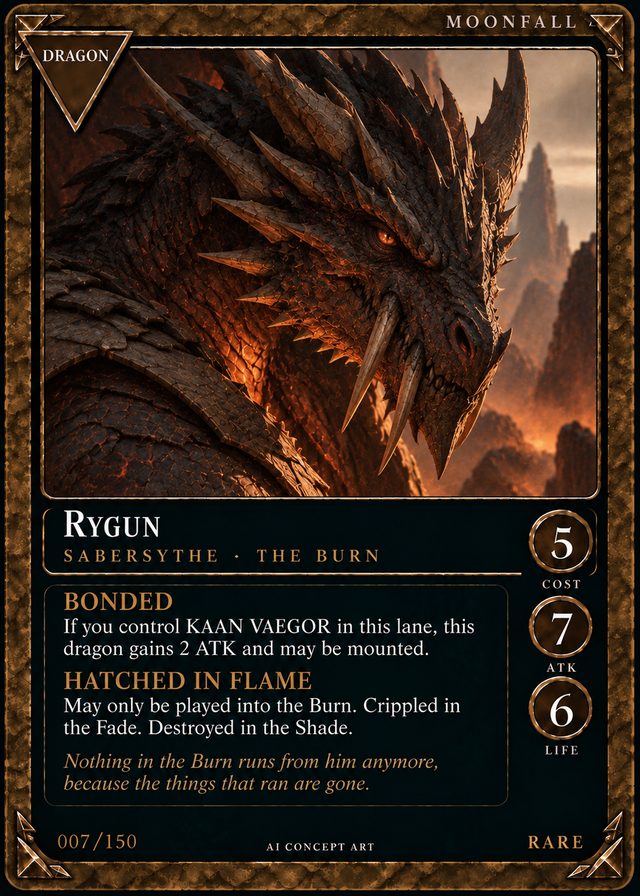
A Burn dragon, dying anywhere else
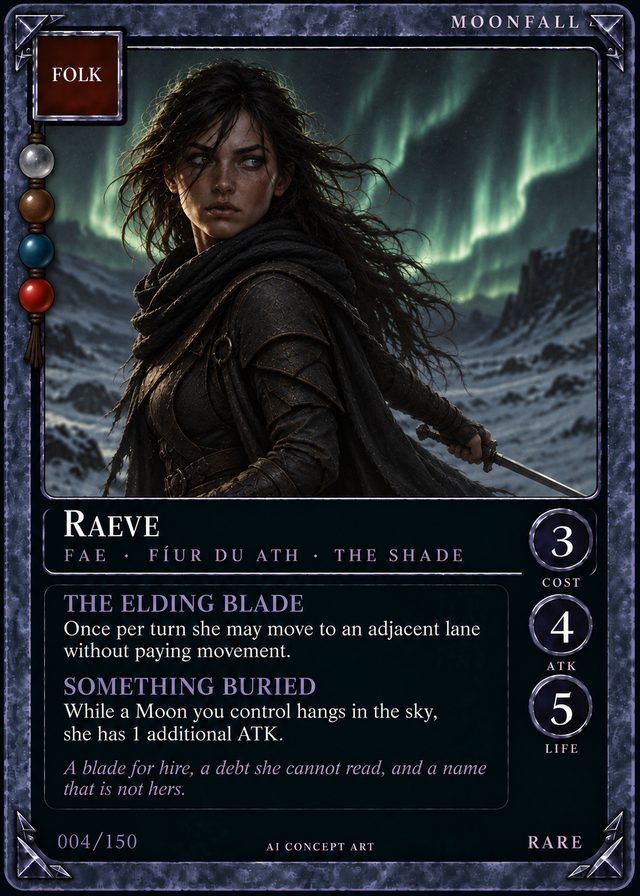
A Shade hero, at home in the dark
The signature mechanic

The Raid.

A dragon in the wrong realm does not die instantly. It is crippled, and it has one cycle. So every attack into hostile ground is a raid with a clock on it: go in, hit, and get out, or lose the best thing you own.

The attacker

Commit or send something cheap

Your Sabersythe is your best piece and it starts dying the moment it enters the Shade. Bring it anyway, or bring something that survives and does less.

The defender

The hunted picks the terrain

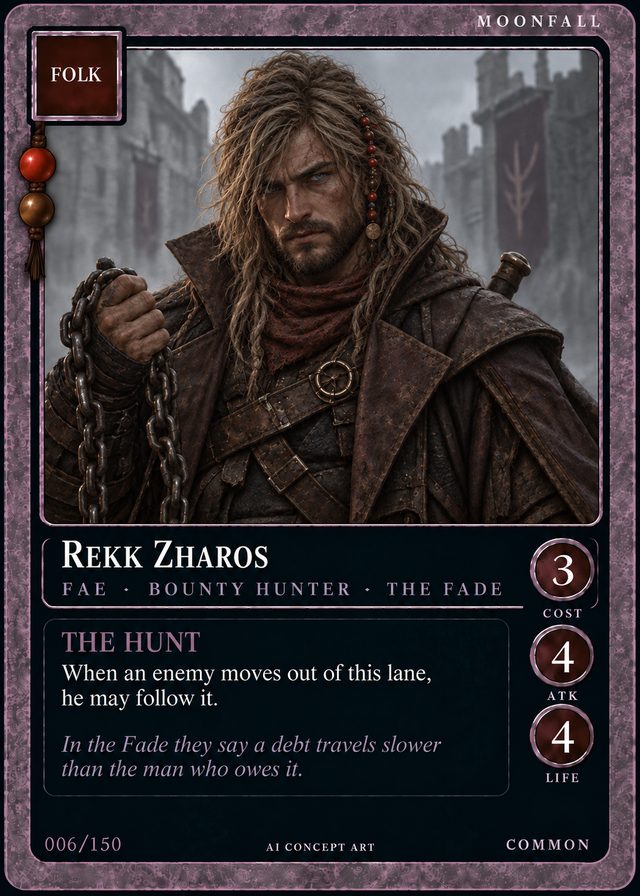
You stand your hero in the realm that is worst for them. Hiding in the dark because their dragons cannot follow is the whole relationship between Raeve and Rekk Zharos, played out on a table.

The result

Nobody is safe anywhere

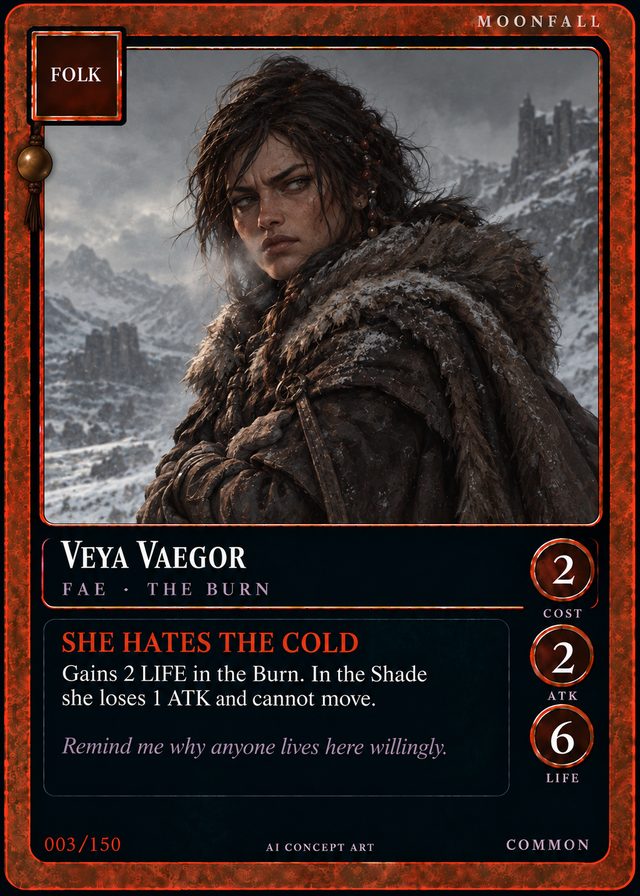
Defence costs you something too, because named characters carry their own relationships to the realms. Veya hates the cold and the card says so.

The cards

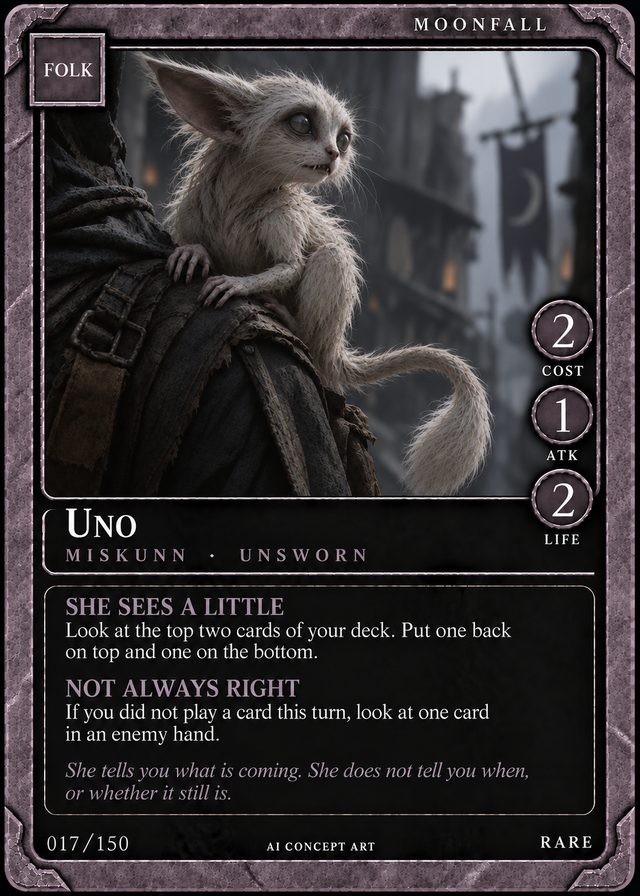
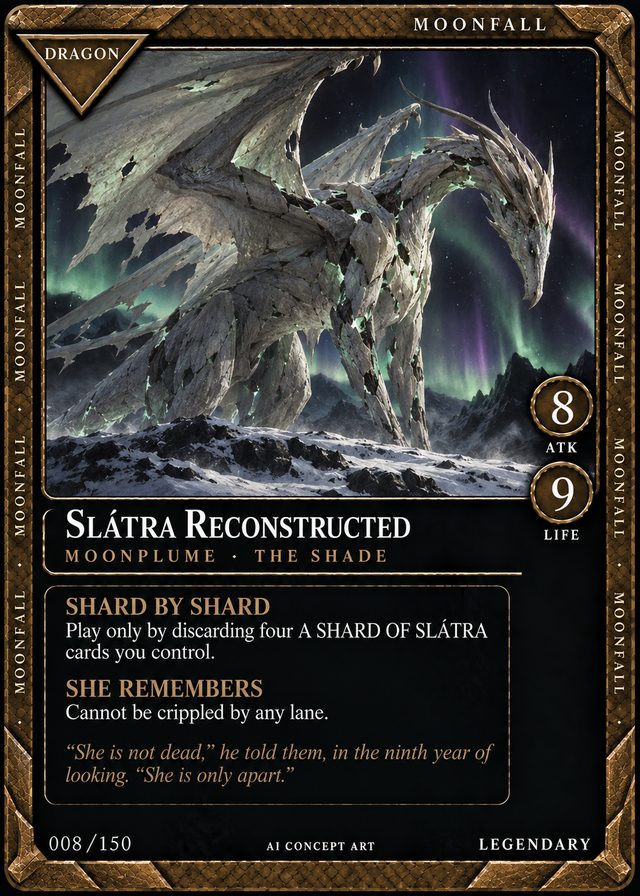
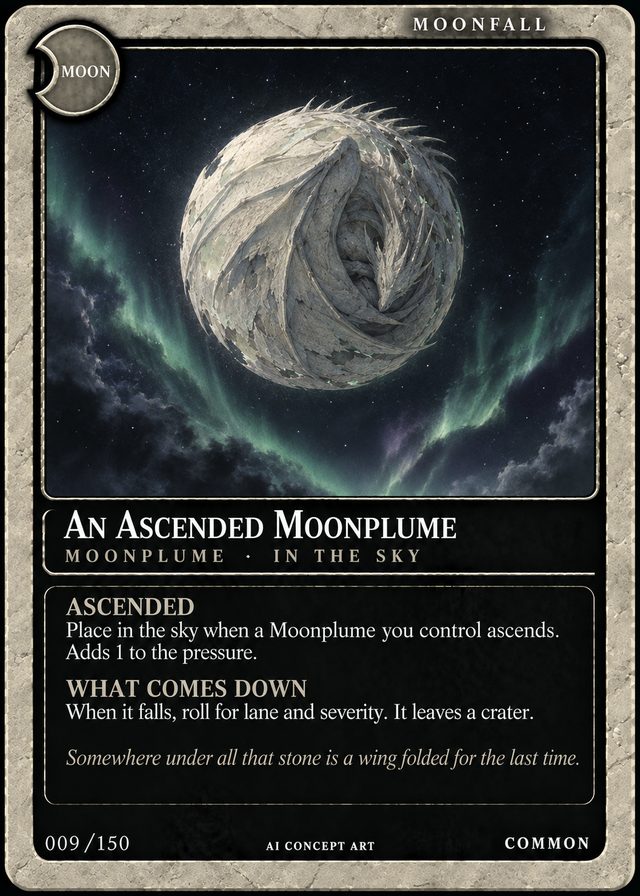
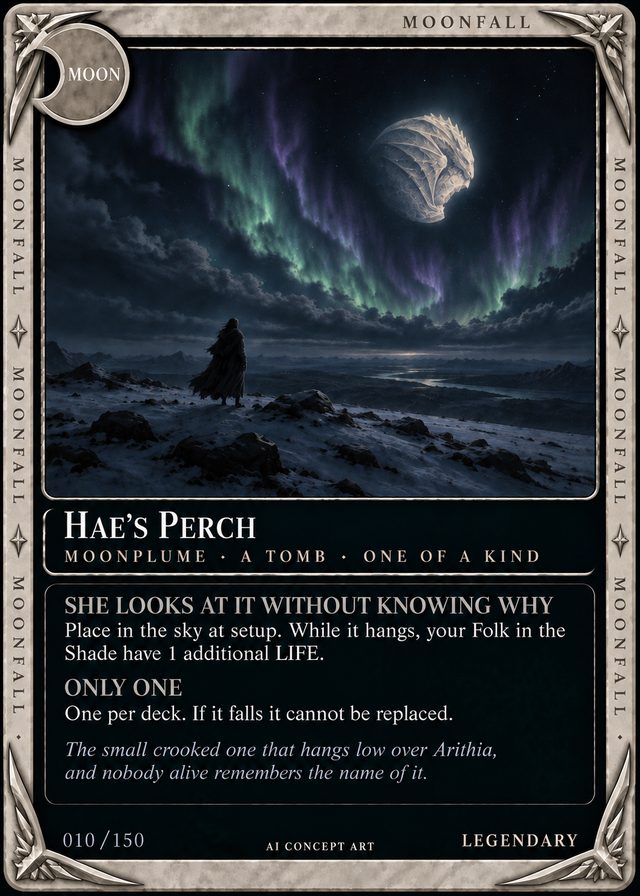
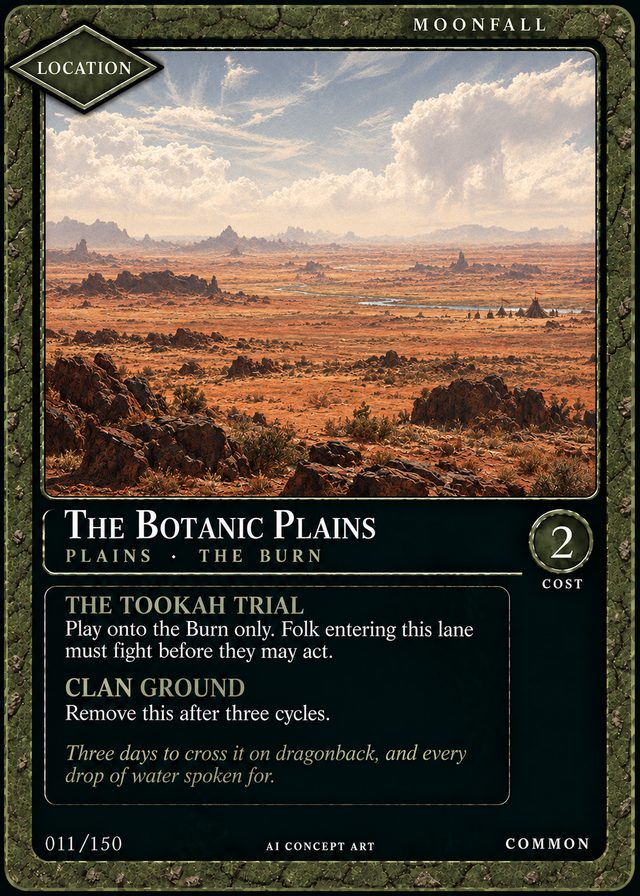
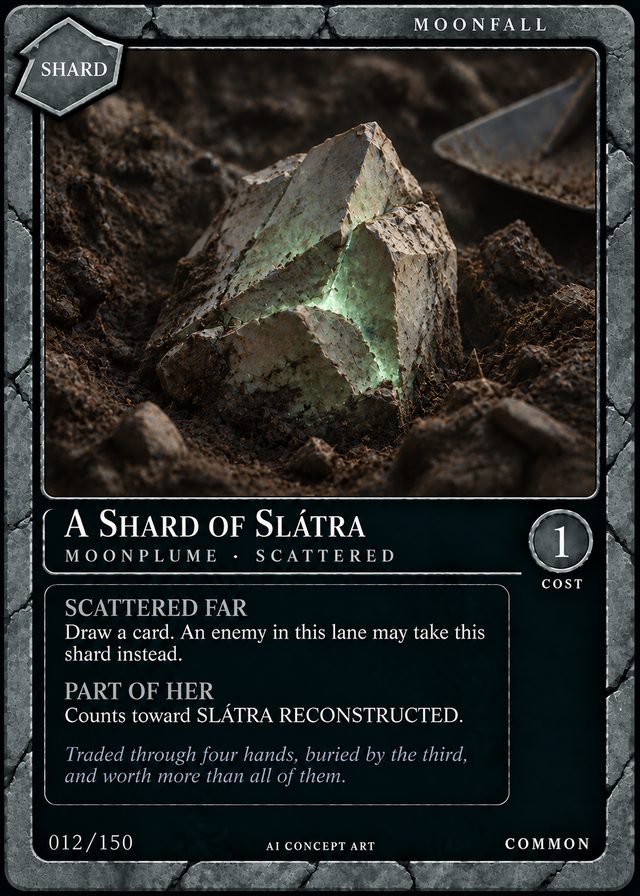
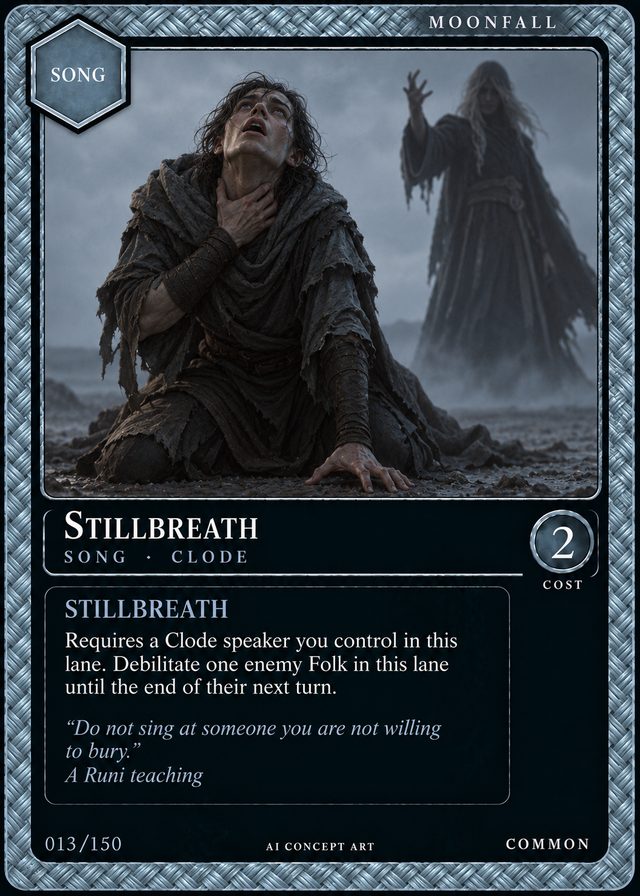
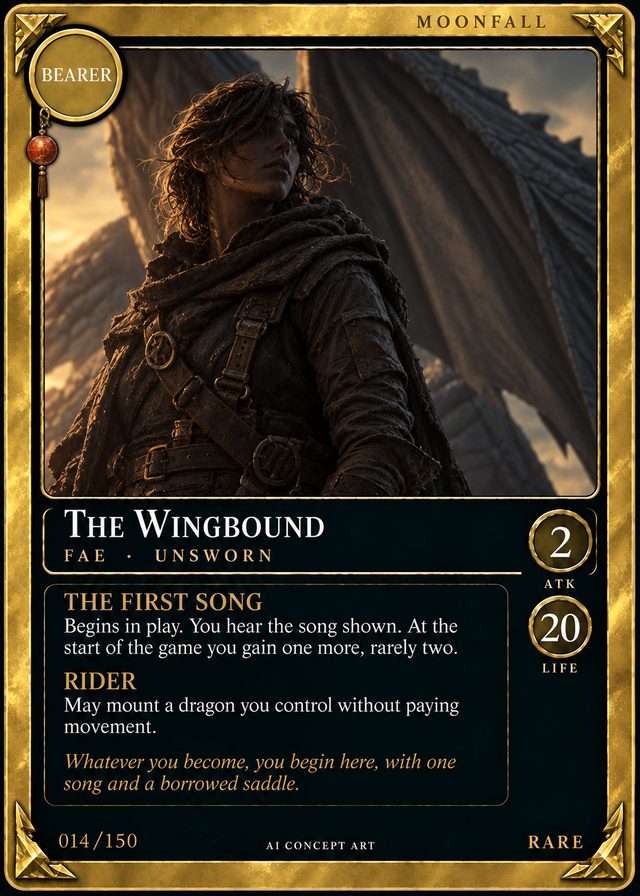
Seventeen built.
One hundred and fifty planned.
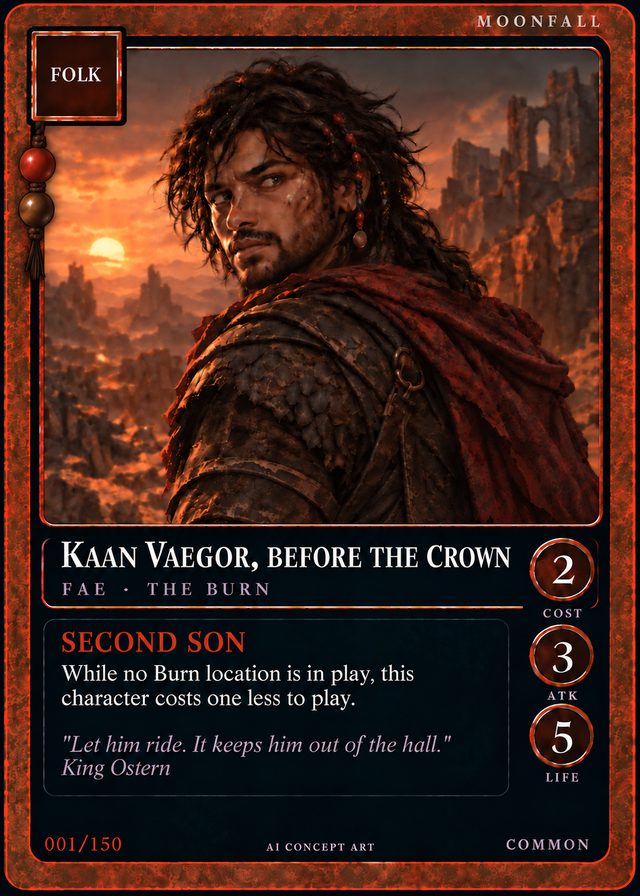
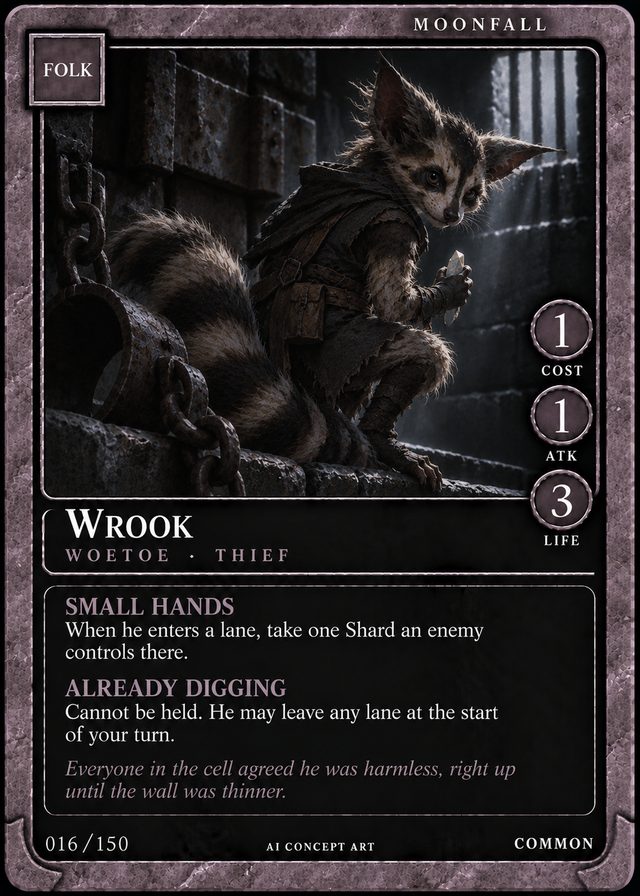
Placeholder art only. Final art would be commissioned. Every image here is AI-generated concept art, marked as such on each card face, and exists to show the frame system and the world. It would be replaced entirely.
AI never touches the game design. Mechanics, card text, costs and abilities are written by us. No published artwork from the series has been used or imitated anywhere in this deck.
The system

The magic system is
legible on the card.

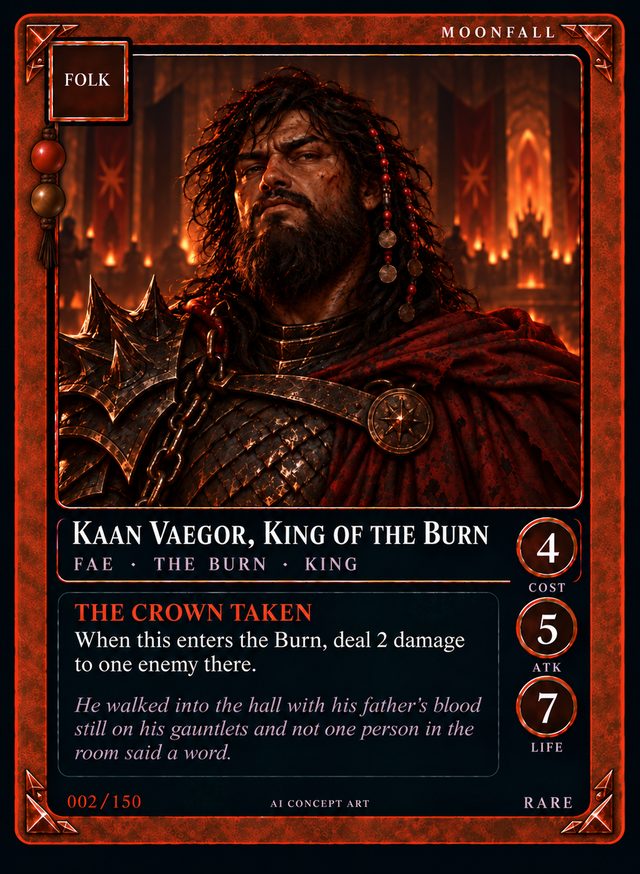
Affinity is worn as beads in the books, so the cards wear it too. A bead per song runs down the left edge of every character. Kaan carries two. Veya carries one. Raeve carries four, and you know she is extraordinary before you read a word of her text.

Frame colour carries realm for Folk and card type for everything else. Corner work carries rarity. Three separate signals, none of them doing another one's job, so a card is readable from its edge in a stack.

Origin and affinity are different things and the cards keep them apart. Veya is of the Burn and hears only Bulder, so her frame is Burn red and her single bead is brown.
Four songs, worn openly
One bead, red frame
The cast

Three cards.
One person.

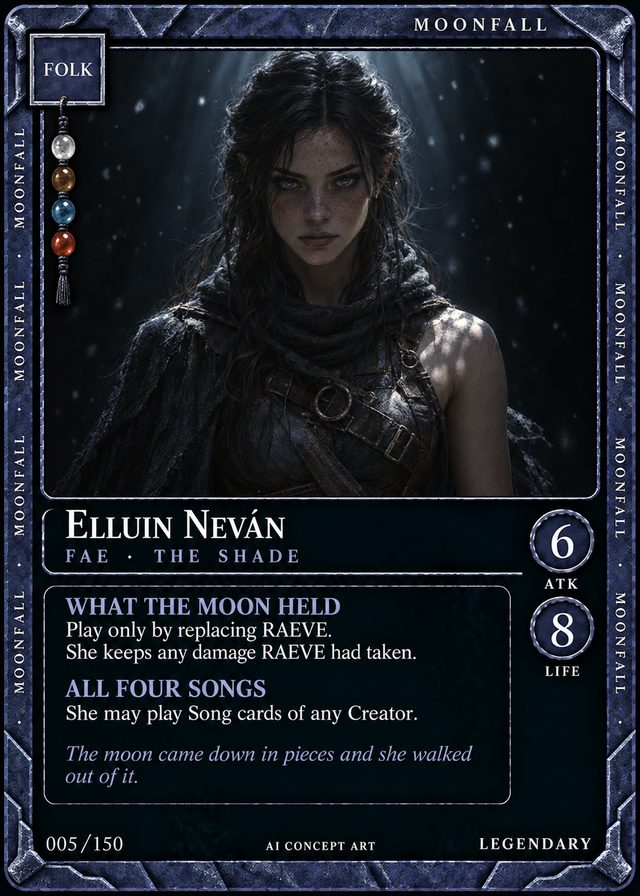
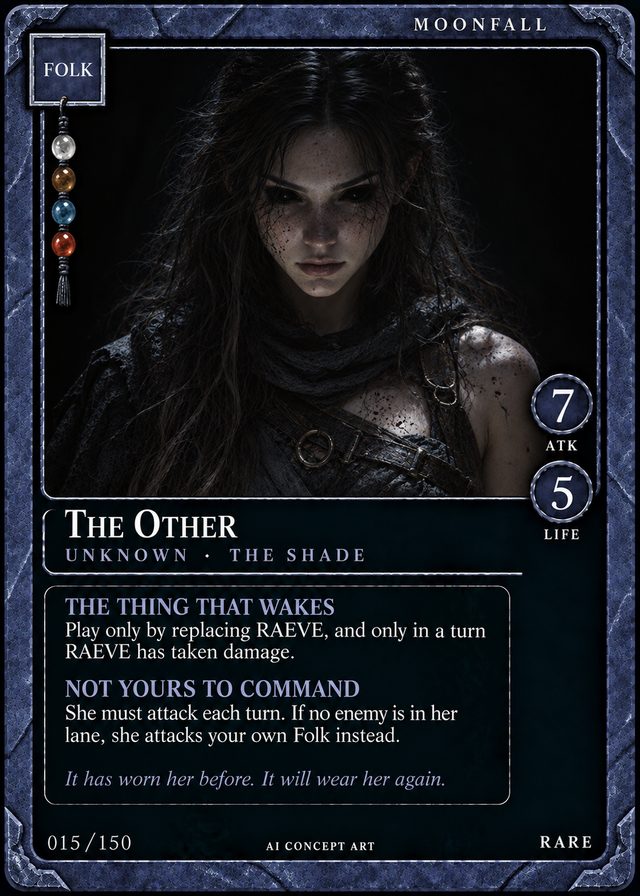
Raeve plays normally. Elluin can only enter by replacing her. The Other can only enter in a turn Raeve has taken damage, and once she is out she attacks every turn, even when the only target left is your own side.

Raeve
Elluin Neván
The Other

The players you embody are archetypes. The named cast are cards you play with

Skripi

We did not build
Sarah's game.

Skripi is the obvious thing to reach for and we deliberately left it alone.

What the books describe is roughly a fifth of a game. There is a grid of shards, dice, a hand, a swap loop, a final lay, and one clever wildcard. What is missing is everything that decides who wins.

Building it without Sarah would mean inventing the rest and then handing her a finished thing to disagree with. If Skripi becomes real, she should lead it and we would want to help her realise her version of it.

What we did instead

We stayed off her ground

Skripi is played with shards. So we cut shards from our game as a general system entirely, and kept only Slátra's, which are a specific story rather than an economy.

That was a real design cost and we paid it on purpose, so the two games stay clearly separate.

Readers are already asking for it. The rules are never explained on the page and people have noticed. That demand is real. It just belongs to her.
Why this world

The audience already
buys the objects.

2
subscription boxes have produced special editions of this series, in collaboration with the publisher and the author
5
books planned, which is a content runway rather than a single set
3
realms with fixed colour identity, already built for faction design
4
Creator songs with stated bead colours, already built for an affinity system

A readership that already spends on foiled editions and character art is a readership that buys cards. And the romantasy shelf has almost no trading card game on it, which is unusual for a category this size.

Straight with you

What we don't have yet.

The concept is done. The game is not. The engine works on paper and seventeen cards exist. It has not been playtested, the numbers on these cards are placeholders, and one system is still open.
We have read book one. Book two is out and not yet reflected here, and we would want to go through it with you before anything is locked.
We got something wrong and fixed it. One location card was built on a claim that turned out not to be in the text. We caught it, rebuilt the card, and tightened our sourcing. We would rather tell you that than have you find it.
Printing Elluin is your call. Her card puts the central twist of book one on a card face while the series is unfinished. We built it to show the mechanic. Whether it ships is a question for you and Sarah.
The roadmap

One set is a game.
Five books is a franchise.

Set one

When the Moon Hatched

150 cards. The three realms, the Vaegor line, the Fíur du Ath, the dragons, and the moons already in the sky.

Set two

The Ballad of Falling Dragons

Book two brings new characters, new ground and whatever the series does next to the moons. The publishing schedule is the release schedule.

Sets three and beyond

Yet to be written

A five-book plan means the set list is already drafted by someone else. We follow it.

And a companion app, later. A code on your hero card that rolls which songs you hear, so no two sessions start the same. Good idea, bad dependency. The physical game works alone first.
Ownership

You own the world.
We design the game.

Every character, place, term and image in this world belongs to Sarah A. Parker and her publishers. Nothing in this deck claims otherwise and nothing would.

What we bring is the engine: the lane structure, the raid, the affinity system, the combat maths, the card architecture and the rules that hold them together. That work is ours and it comes to the table with us.

The player is nobody from the books. You embody an archetype we wrote. That choice exists specifically so we are never deciding what Raeve can do or putting words in Kaan's mouth. The named cast stay cards you play with.
An archetype, written by us
A named character, played as a card
Why Pamplemoose Games

A two-designer studio that
builds card games.

HAVOC: Gen Zero, the card game we designed, funded on Kickstarter in under thirty minutes.

Since then we have designed card games across licensed worlds and original ones, working the same way every time: read the source properly, derive the mechanics out of what is already there, and never ask the IP to bend around a system we brought with us.

This deck is the evidence of that method. The beads, the realms, the dragons dying in the wrong sky. None of it was invented for the game. All of it was already on the page.

The studio

Zack Howe and Cole Beardsley

Two designers. Every game we make gets designed by both of us, start to finish.

Based in Madison, Wisconsin.

Zack is also a published novelist. Which mostly means he knows what it feels like to hand a world to somebody else, and takes that seriously.
Next

We'd like to talk about
the hunt.

The first thing we need is not a deal. It is to understand where game and merchandising rights sit for this series, and whether there is appetite to explore this at all.

After that: a conversation with you and Sarah. We would want her on it early rather than late, because the questions worth asking are hers to answer.

1

A call, with Sarah on it.

2

Prototype and playtest, once the direction is agreed.

3

Publisher or crowdfund, whichever fits how you want this to reach readers.

Numbers come later. This is a conversation first.

Zack Howe
Pamplemoose Games LLC · with Cole Beardsley
zack@pamplemoosegames.com

When the Moon Hatched and The Moonfall Series, including all characters, places, names and terms, are the property of Sarah A. Parker and her publishers. They appear in this deck solely to demonstrate a game concept. No published artwork from the series has been used, reproduced or imitated; all images shown are original AI-generated concept art, marked as such, and would be replaced by commissioned work. All game mechanics, card architecture and rules text are original to Pamplemoose Games LLC. No rights are claimed or implied. Not for distribution.